Guidance, proven in results.
Live, exam-board-specific online tuition for GCSE and A-Level students, taught by experienced classroom teachers with examiner experience.
Small groups · Live teaching · Exam practice · Live written feedback
2×
Live lessons
per teaching week
30 min
GCSE
lessons
40 min
A-Level
lessons
15
Max students
per group
Science and Economics meet twice a teaching week. English runs on a fortnightly rota — see the full timetable.
Teacher-led, from start to finish.
Every tutor, every subjectChecks and training are held for every tutor and reviewed annually.
Not another revision subscription.
Students are taught live by a subject specialist. They answer questions, make notes, apply what they have learned and receive feedback during the lesson.
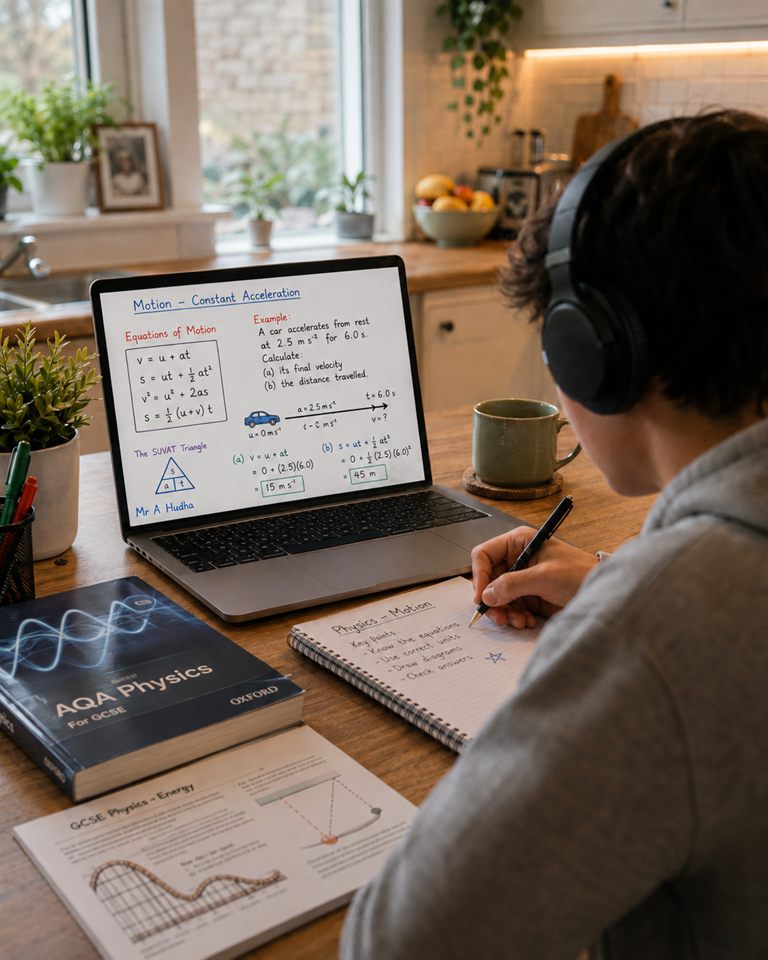
Science · Mr A Hudha
Specialist teaching, built around the exam your child will actually sit.
Each programme is taught around the relevant specification, question styles and mark scheme — not a generic version of the subject.
GCSE
IGCSEBiology, Chemistry & Physics
A-LevelPhysics
A-LevelEconomics
GCSE
A-LevelEnglish Language & Literature
Explanation, application, exam practice, every lesson.
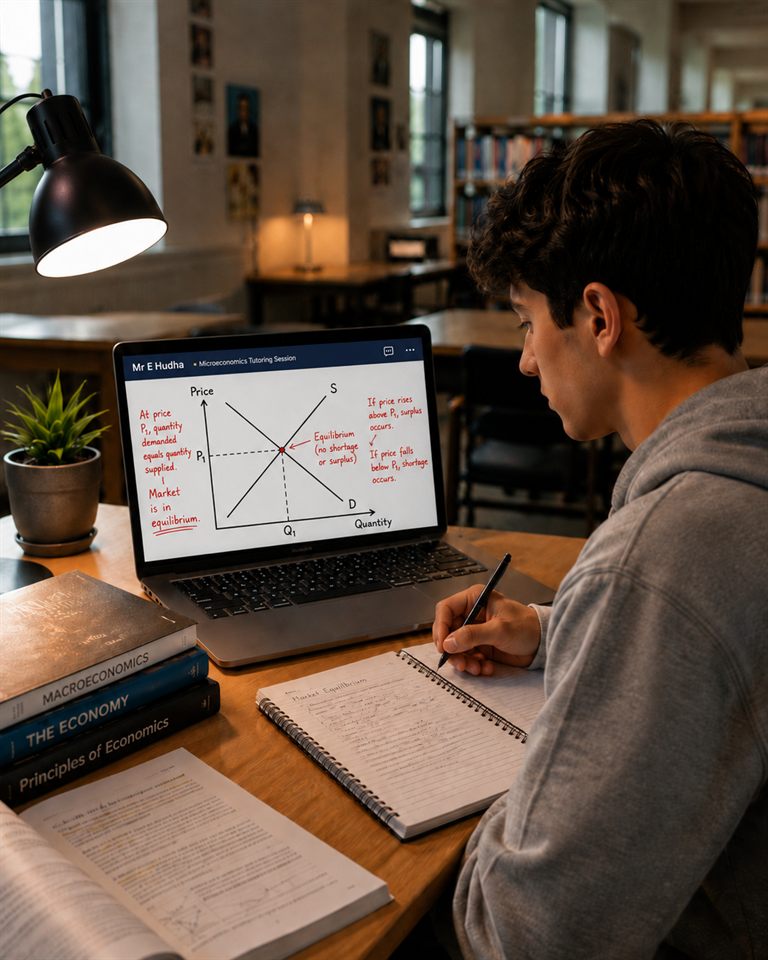
Concepts are modelled on screen, then students apply them straight away in writing. Every Economics lesson closes with real exam-question practice, so understanding is tested before the lesson ends, not weeks later.
Economics · Mr E Hudha
No passive watching.
Students are expected to think, write and respond throughout the lesson. Misconceptions are identified early, exam questions are modelled explicitly and students are shown how to improve.
Know what your child is learning — and what comes next.
Every programme follows a published curriculum map, so students and parents can see how the specification is being covered across the academic year.
View Curriculum Maps →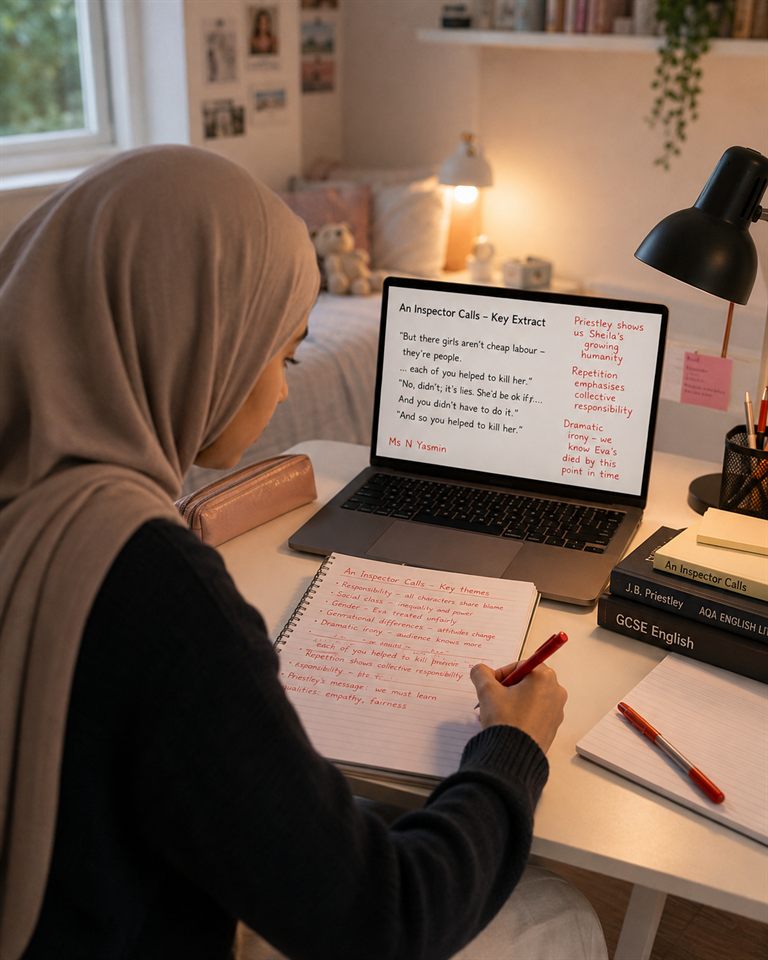
Feedback while they are still thinking.
During exam practice, tutors can review written work live, annotate responses and show students exactly how to improve.
English · Ms N Yasmin
The classroom record behind the teaching.
These results come from school cohorts taught directly by our founding teachers — the same specialists who teach GuideMyGrades programmes, not historic GuideMyGrades tutoring cohorts.
Where their students went next.
Students taught by our founders in their school classrooms have progressed to leading universities across the UK.
-
Oxford University of Oxford
-
Cambridge University of Cambridge
-
LSE London School of Economics and Political Science
-
Imperial Imperial College London
-
UCL University College London
-
King's College London King's College London
-
Warwick University of Warwick
-
Manchester University of Manchester
-
Nottingham University of Nottingham
-
Bath University of Bath
-
Queen Mary Queen Mary University of London
Universities listed: University of Oxford, University of Cambridge, London School of Economics and Political Science, Imperial College London, UCL, King's College London, University of Warwick, University of Manchester, University of Nottingham, University of Bath, Queen Mary University of London.
These are destinations of students taught by our founders during their school careers, not of GuideMyGrades tutoring cohorts, since our first intake begins in September 2026. University names are used to describe where students went and do not imply any partnership with or endorsement by those institutions.
Two live lessons every teaching week. One simple monthly price.
Specialist teaching without the cost of traditional 1-to-1 tuition.
GCSE
Welcome offer£50 first month
then £80/month
teaching week
lesson
- Live small-group teaching
- Exam-board-specific tuition
- Exam practice & live feedback
- Curriculum resources
A-Level
Welcome offer£80 first month
then £100/month
teaching week
lesson
- Live small-group teaching
- Exam-board-specific tuition
- Exam practice & live feedback
- Curriculum resources
Science and Economics meet twice a teaching week. English runs on a fortnightly rota — see full pricing for detail.
View Full PricingFounded by three qualified classroom teachers.
18 plus
Years combined
teaching experience
15,000 plus
Lessons
taught
2,500 plus
Students
taught
14
Schools taught
across
Mr A Hudha
Co-Founder & Science Lead
Mr E Hudha
Co-Founder & Economics Lead
Ms N Yasmin
Co-Founder & English Lead
Find the right programme for your child.
Live online tuition taught by qualified classroom teachers with examiner experience. Choose the subject and level your child studies, then find the programme that fits.
Clear teaching. Small groups. Exam practice and feedback built in.
See exact session times for every programme →
Choose your live programme.
Choose the subject and level your child studies, then review the tutor, timetable, lesson format and price before requesting a place.
GCSE Science teaching is designed to cover the required content across the major exam boards we support: AQA, Pearson Edexcel and OCR. Where specifications differ, the relevant exam-board requirements are made clear within teaching and exam practice.
Small groups, opened rather than overfilled.
Programmes launch with 5 students and are capped at 15. Students are expected to participate throughout, and when demand is high we open another group rather than overcrowd the class. Why we cap groups at 15.
5
Students to launch
15
Maximum group size
2×
Live lessons/week
Science & Economics only
Your weekly lesson timetable.
Science and Economics run every teaching weekend. English follows a two-week rota, alternating between Language and Literature. Switch between UK and UAE time below.
English · Ms N Yasmin
English follows a two-week rota: English Language Week, then English Literature Week. GCSE sessions are 30 minutes and A-Level sessions are 40 minutes.
Week A
ENGLISH LANGUAGE WEEK
Week B
ENGLISH LITERATURE WEEK
The English Language and English Literature weeks alternate throughout the teaching year.
Science · Mr A Hudha
Science lessons run every teaching weekend. GCSE/IGCSE sessions are 30 minutes and A-Level sessions are 40 minutes, with short breaks between consecutive lessons.
Boards supported: AQA · Pearson Edexcel · OCR A · Cambridge International · Pearson Edexcel International
GCSE/IGCSE teaching supports Separate/Triple Science and the relevant content within Combined Science.
Economics · Mr E Hudha
Economics runs every teaching weekend. Year 12 covers the shared AQA and Pearson Edexcel A core; Year 13 is currently Pearson Edexcel A. All sessions are 40 minutes.
SATURDAY · MICROECONOMICS SUNDAY · MACROECONOMICS
UK time is shown by default. Switch to UAE time above to see the equivalent local lesson times.
Lesson times remain consistent throughout the teaching year.
View Academic CalendarPlan the academic year with confidence.
All teaching weekends and planned breaks for 2026/27 are published below, so families can plan ahead with clarity.
Autumn term
Autumn 1
5 September – 18 October 2026
7 teaching weekendsAutumn half-term
24 October – 8 November 2026
No lessonsAutumn 2
14 November – 13 December 2026
5 teaching weekendsChristmas holiday
19 December 2026 – 3 January 2027
No lessonsSpring term
Spring 1
9 January – 7 February 2027
5 teaching weekendsSpring half-term
13 – 21 February 2027
No lessonsSpring 2
27 February – 21 March 2027
4 teaching weekendsEaster holiday
27 March – 11 April 2027
No lessonsSummer term
Summer 1
17 April – 23 May 2027
6 teaching weekendsSummer half-term
29 May – 6 June 2027
No lessonsSummer 2
12 June – 18 July 2027
6 teaching weekendsFinal teaching day
18 JULY 2027
End of academic yearCalendar = when we teach. Curriculum Maps = what we teach.
Use both together to see how each programme progresses across the academic year.
View Curriculum MapsKnow what your child will learn — and when.
Every programme is mapped across six half-term teaching blocks. The full specification is covered across the year, with more time given to difficult and high-value topics. Exam practice, modelling and live feedback are built in throughout.
Full specification mapped
Every examinable area has a clear place in the year.
Difficult topics prioritised
More teaching time is given to areas students typically find hardest.
Exam practice throughout
Questions, modelling and feedback are built in from the start.
Choose a programme below to see how learning progresses across the six teaching blocks.
Science
GCSE/IGCSE Biology All major boards
Year 1
- Autumn 1Cell biology
- Autumn 2Organisation
- Spring 1Infection & response
- Spring 2Bioenergetics
- Summer 1–2Consolidation & exam-question practice
Year 2
- Autumn 1Homeostasis & response
- Autumn 2Inheritance, variation & evolution
- Spring 1Ecology
- Spring 2 – Summer 2Past papers & exam technique
Core topics common to AQA, Edexcel, OCR and Cambridge/Edexcel International GCSE Biology.
GCSE/IGCSE Chemistry All major boards
Year 1
- Autumn 1Atomic structure & periodic table
- Autumn 2Bonding, structure & properties
- Autumn 2Quantitative chemistry
- Spring 1Chemical changes
- Spring 2Energy changes
- Summer 1–2Consolidation & exam-question practice
Year 2
- Autumn 1Rate & extent of chemical change
- Autumn 2Organic chemistry
- Spring 1Chemical analysis
- Spring 1Atmosphere & using resources
- Spring 2 – Summer 2Past papers & exam technique
Core topics common to AQA, Edexcel, OCR and Cambridge/Edexcel International GCSE Chemistry.
GCSE/IGCSE Physics All major boards
Year 1
- Autumn 1Forces
- Autumn 2Energy
- Spring 1Electricity
- Spring 1Particle model of matter
- Spring 2 – Summer 1Waves
- Summer 2Consolidation & exam-question practice
Year 2
- Autumn 1Atomic structure
- Autumn 1Radioactivity
- Autumn 2Magnetism & electromagnetism
- Spring 1Space physics (Triple only)
- Spring 2 – Summer 2Past papers & exam technique
Core topics common to AQA, Edexcel, OCR and Cambridge/Edexcel International GCSE Physics. Radioactivity is taught as its own block in our teaching order.
A-Level Physics, Year 12 AQA reference spec
Autumn term
- Autumn 1Measurements & their errors
- Autumn 1–2Mechanics
Spring term
- Spring 1Materials
- Spring 1Waves
- Spring 2Electricity
Summer term
- Summer 1Revisiting high-value topics (Mechanics, Waves)
- Summer 2Past papers & exam-question practice
Based on AQA A-level Physics (7408), topics 1, 3–5. Mechanics and Materials are taught as two separate blocks, with Particles and Radiation moved to Year 13.
A-Level Physics, Year 13 AQA reference spec
Autumn term
- Autumn 1Particles & radiation
- Autumn 1Further mechanics & thermal physics
- Autumn 2Fields & their consequences
Spring term
- Spring 1Nuclear physics
- Spring 2Optional topic (e.g. Astrophysics)
Summer term
- Summer 1Past papers & practical endorsement
- Summer 2Exam technique & revision to the exams
Based on AQA A-level Physics (7408), topics 2, 6–8 plus one option.
Economics
A-Level Economics, Year 12 AQA & Edexcel shared core
Autumn term
- Autumn 1The economic problem & economic methodology
- Autumn 1Individual economic decision making
- Autumn 2Price determination in a competitive market
Spring term
- Spring 1Production, costs and revenue
- Spring 1Measurement of macroeconomic performance
- Spring 2How the macroeconomy works: circular flow, AD/AS
Summer term
- Summer 1Revisiting high-value analysis & evaluation
- Summer 2Past papers & exam-question practice
Combines AQA (7136) topics 1–4 and 9–10 with Pearson Edexcel A (9EC0) Themes 1–2, the shared core taught to both boards in Year 12.
A-Level Economics, Year 13 Pearson Edexcel A
Autumn term
- Autumn 1Theme 3.1–3.2: business growth & objectives
- Autumn 2Theme 3.3–3.4: revenues, costs, profit & market structures
- Autumn 2Theme 3.5–3.6: labour market & government intervention
Spring term
- Spring 1Theme 4: international trade & the global economy
- Spring 2Theme 4: emerging economies, poverty & the financial sector
Summer term
- Summer 1Past papers across Papers 1–3
- Summer 2Exam technique & revision to the exams
Based on Pearson Edexcel GCE Economics A (9EC0), Themes 3 and 4. Year 13 is currently offered for Pearson Edexcel A only, since by then exam technique is too board-specific to teach AQA and Edexcel together.
English
GCSE English Language AQA
Year 1
- Autumn 1–2Fiction reading & creative writing
- Spring 1 – Summer 1Non-fiction reading & transactional writing
- Summer 2Consolidation & exam-question practice
Year 2
- Autumn 1–2Spoken language study & endorsement
- Spring 1Exam technique across Paper 1 & Paper 2
- Spring 2 – Summer 2Past papers & revision
Based on AQA GCSE English Language (8700). English provision is currently aligned to AQA.
GCSE English Literature AQA
Year 1
- Autumn 1–2Shakespeare play
- Spring 1 – Summer 119th-century novel
- Summer 2Consolidation & essay practice
Year 2
- Autumn 1–2Modern prose or drama text
- Spring 1Poetry anthology & unseen poetry
- Spring 2 – Summer 2Past papers & revision
Based on AQA GCSE English Literature (8702). English provision is currently aligned to AQA. Texts are covered across the published two-week Language/Literature rota — see the Timetable.
A-Level English Literature AQA
Year 1
- Autumn 1–2Love through the ages, poetry
- Spring 1 – Summer 1Love through the ages, prose & drama
- Summer 2Comparative essay practice
Year 2
- Autumn 1–2Texts in shared contexts
- Spring 1Independent critical study (NEA)
- Spring 2 – Summer 2Past papers & comparative essay practice
Based on AQA A-level English Literature A (7712).
A-Level English Language AQA
Year 1
- Autumn 1–2Textual variations and representations
- Spring 1 – Summer 1Children's language development
- Summer 2Analytical essay practice
Year 2
- Autumn 1–2Language diversity and change
- Spring 1Language in action (NEA)
- Spring 2 – Summer 2Past papers & analytical essay practice
Based on AQA A-level English Language (7702).
Your programme. Your year mapped out.
Choose a subject above to see exactly what is taught across the academic year.
Every lesson has a clear purpose.
Students are taught, questioned and expected to apply what they learn. Exam practice and feedback are built into every lesson.
Do Now
Retrieve and revisit previous learning.
Teach
New content explained clearly in manageable steps.
Check
Questions reveal what students understand and what needs correcting.
Apply
Students use the knowledge while the teacher checks progress.
Exam practice
Apply learning to exam-style questions.
Live feedback
Correct mistakes and improve the response immediately.
Active throughout
Students think, write and respond throughout the lesson.
Assessment every lesson
Exam practice shows us what students understand in real time.
Purposeful homework
Short tasks prepare students for the next stage of learning.
Feedback while they are still thinking.
Tutors review written work during the lesson, prompt students to develop incomplete answers and then check the improvement immediately.
Illustrative live-marking example
“Explain one reason why ‘the fall in the exchange rate of the British pound’ is likely to increase inflation. (5)”
Student’s first answer
Initial · 3/5The fall in the exchange rate means the British pound is worth less.
Imports into the UK will become more expensive.
This can increase firms’ costs and cause inflation.
Mr E Hudha · live feedback
Red pen- What happens to the price of UK exports for overseas buyers?
- How does this affect exports and net exports (X−M)?
- Which curve would shift on an AD/SRAS diagram?
- What happens to the general price level?
Student self-correction
Green penUK exports become relatively cheaper to overseas buyers, so exports increase and net exports (X−M) rise.
This causes AD to shift right from AD1 to AD2, increasing the general price level from P1 to P2 and causing demand-pull inflation.
We don’t just mark mistakes. We prompt students to identify what is missing, improve the answer themselves, and check the improvement live.
Small group. Every student visible.
Students participate throughout the lesson. Regular questioning, written work and attendance checks help tutors identify quickly when someone is unsure or falling behind.
Regular questioning
We check understanding across the whole group, not only from students who volunteer.
Written work
Students regularly apply what they have learned, giving tutors evidence of real understanding.
Attendance
Attendance is monitored so patterns are noticed early.
Cameras are never required. Participation is measured through questioning, written work and lesson activity, not whether a camera is switched on.
Structured teaching, not improvised tutoring.
Clear explanations
New ideas are broken into manageable steps.
Check understanding
Questions expose misconceptions before they become habits.
Model the standard
Students see what a strong answer looks like before attempting their own.
Practise & improve
Knowledge is applied through exam-style work and feedback.
This helps every student, and it particularly helps some. All three of us are SEN trained, and we build these adjustments in as standard rather than offering them on request. If your child has a specific need, tell us when you enquire and we will be honest about whether a group of this size is right for them.
Watch before you decide.
See how our tutors actually teach before choosing a programme. These are the same teachers, explanations and teaching styles students experience in GuideMyGrades lessons.
Everything you need, in one place.
Google Meet
Join the same live lesson link each week.
Google Classroom
Access homework, exam practice, lesson tasks and previous materials.
Google Drive
Find shared curriculum resources and supporting materials.
Live, not recorded
Lessons are interactive and are not recorded. If a student misses a lesson, the relevant materials remain available online.
Your first lesson, made simple.
Join the real class, meet your teacher and experience our teaching from the very first lesson.
Join the live class
Join the lesson already scheduled for your programme. No separate introductory or sales session.
Learn with the group
Your teacher introduces and models the content using the same approach experienced by enrolled students.
Apply what you learn
Students answer questions, write independently and apply the teaching to exam-style work.
Receive live feedback
Your teacher checks understanding, identifies what needs improving and gives feedback while the lesson is still running.
Your first lesson is the real programme, not a demonstration.
Experience the teacher, teaching style, level of participation and exam-focused approach before deciding whether the programme is right for you.
Ready to experience a lesson?
View ProgrammesClear communication. No guesswork.
You should never be left wondering whether your child is attending, participating or making progress. We monitor the things that matter and raise concerns early when something needs your attention.
Attendance
We monitor attendance so repeated absences or patterns do not go unnoticed.
Progress
Classwork and exam practice show us what your child understands, where misconceptions remain and where further support is needed.
Communication
If something important needs addressing, we raise it early rather than waiting until the end of term.
Contact your teacher
Questions about your child’s learning can be directed to the teacher responsible for their programme.
Professional teaching. Clear safeguarding standards.
Qualified teachers · Enhanced DBS checked · Safeguarding trained · Full-time classroom practitioners
Safeguarding and professional boundaries are built into how GuideMyGrades operates.
Safeguarding Policy · Privacy Notice
Still have a question?
Contact UsChoose how you want to learn.
Choose a single lesson, pay monthly, or save by joining for the full academic year.
Same live teaching. Same programme. Different ways to pay.
Qualified teachers · Examiner experience · Live teaching · Published curriculum · Exam-focused feedback
GCSE Pay As You Go
For occasional support or a particular topic.
£10 Per lesson- 30-minute live lesson
- Join a scheduled GCSE lesson
- Choose a relevant topic from the curriculum
- No monthly commitment
GCSE Monthly Programme
For consistent teaching across the academic year.
then £80/month
Save £30- 2 live lessons per teaching week
- 30 minutes per lesson
- Full programme access
- Published curriculum map
- Exam practice and live feedback
- Google Classroom resources
- Parent progress updates
GCSE Annual Programme
Lowest total cost for families committing to the academic year.
£800 For September–July- Covers September to July
- 2 live lessons per teaching week
- 30 minutes per lesson
- Full programme access
- One upfront payment
- Lowest total price across the academic year
- Includes an additional annual saving beyond the Welcome Offer
A-Level Pay As You Go
For occasional support or a particular topic.
£15 Per lesson- 40-minute live lesson
- Join a scheduled A-Level lesson
- Choose a relevant topic from the curriculum
- No monthly commitment
A-Level Monthly Programme
For consistent teaching across the academic year.
then £100/month
Save £20- 2 live lessons per teaching week
- 40 minutes per lesson
- Full programme access
- Exam-board-focused teaching
- Published curriculum map
- Exam practice and live feedback
- Google Classroom resources
- Parent progress updates
A-Level Annual Programme
Lowest total cost for families committing to the academic year.
£1,020 For September–July- Covers September to July
- 2 live lessons per teaching week
- 40 minutes per lesson
- Full programme access
- One upfront payment
- Lowest total price across the academic year
- Includes an additional annual saving beyond the Welcome Offer
Pay-as-you-go students join a real scheduled lesson, experiencing the same tutor, teaching style and programme as enrolled students.
Simple payments. No surprises.
Monthly
Your first month uses the Welcome Offer. Standard monthly pricing applies thereafter, with payments taken on the 1st of each month.
Annual
Pay once for the September–July academic year and receive the lowest total price.
Pay as you go
Book an individual scheduled lesson when you need support with a particular topic.
More than a weekly video call.
No lock-in. No surprises.
Join late
You can join during the academic year and access previous programme materials.
Miss a lesson
The relevant learning materials remain available online.
We cancel
If GuideMyGrades cancels a scheduled lesson, a replacement lesson will be arranged.
Leaving
Cancellation terms are clearly set out before enrolment.
Ready to choose your programme?
Choose the option that works for your family and request your place.
Founded and taught by three qualified classroom teachers.
Hudha means guidance in Arabic. Our programmes are led by subject specialists with current classroom experience, strong subject expertise and a proven understanding of the exams they teach.
18 plus
Years combined
teaching experience
15,000 plus
Lessons
taught
2,500 plus
Students
taught
14
Schools taught
across
UK-trained teachers. Internationally accessible.
United Kingdom
All three founders trained and qualified in the UK. Mr E Hudha teaches from London.
United Arab Emirates
Mr A Hudha and Ms N Yasmin teach from Dubai, bringing UK-trained teaching to families in UAE-friendly timezones.
Ms N Yasmin
Co-Founder & English Lead
Dubai, UAE
- GCSE English Language
- GCSE English Literature
- A-Level English Literature
- A-Level English Language (AQA)
- 8 years classroom teaching experience
- BA English, Russell Group university
More experience
- PGCE Secondary English
- Examiner experience in English Language & Literature
- Provides EPQ (Extended Project Qualification) supervision
Mr A Hudha
Co-Founder & Science Lead
Dubai, UAE
- GCSE/IGCSE Biology, Chemistry & Physics
- A-Level Physics (Years 12 & 13)
- 10+ years classroom teaching experience
- 5 years as Head of Physics
More experience
- BEng Mechanical Engineering, Russell Group university
- PGCE Secondary Science
- Seneca Learning Physics Lead
- SEN trained · Provides EPQ supervision
Mr E Hudha
Co-Founder & Economics Lead
London, UK
- Year 12 A-Level Economics (AQA + Edexcel A core)
- Year 13 A-Level Economics, Pearson Edexcel A
- BA Economics, University of London (top 5% of cohort)
- 6 years classroom teaching experience
More experience
- 2 years as school Subject Lead for Business & Economics
- PGDE via the Teach First programme, Bath Spa University
- SEN trained
As GuideMyGrades grows, every tutor will be an experienced qualified teacher selected through a rigorous recruitment process.
The classroom record behind the teaching.
Before GuideMyGrades, our founders built their track records in schools across London and Dubai. Every result shown below comes from a school cohort taught directly by the named teacher and is labelled transparently as such.
From London classrooms to Dubai.
Across London academy schools serving disadvantaged communities and an international school in Dubai, Mr A Hudha’s A-Level Physics results demonstrate a strong classroom record across different educational settings.
Every cohort shown was taught directly by Mr A Hudha.
Mr A Hudha · Physics
A-Level Physics
Mr A Hudha’s 2023 and 2024–25 cohorts were taught in London schools serving high-deprivation communities, before his move to teaching in Dubai.
Source & methodology
Three years. Three different London schools.
Across two London academy schools serving disadvantaged communities and one London grammar school, every A-Level Economics cohort shown achieved 100% A*–C.
Every cohort shown was taught directly by Mr E Hudha.
Mr E Hudha · Economics
A-Level Economics
Source & methodology
Results shown are from school cohorts taught directly by GuideMyGrades’ founding teachers. They are not historic GuideMyGrades tutoring cohorts. School names are anonymised to protect students and institutions. Where benchmark comparisons are shown, appropriate same-year subject-level figures are used.
In their own words.
Real messages from students taught directly by our teachers. Select a subject to hear from the students they taught.
These testimonials were written by former students taught directly by our teachers in their school classrooms. They are not historic GuideMyGrades tutoring cohorts. Names are shown as supplied and original messages are held on file.
Bring this classroom experience into your child’s weekly tuition.
Explore the live programmes taught by the teachers behind these results.
Questions, clearly answered.
Everything parents and students need to know before joining GuideMyGrades, grouped by topic so you can find what matters quickly.
Getting started
8 questionsWhat is GuideMyGrades?
GuideMyGrades is a teacher-led online tutoring company built around live teaching rather than passive revision content. Our programmes are taught by qualified classroom teachers with real school experience, subject expertise and an understanding of the examinations their students are preparing for. The founders bring the classroom track record shown elsewhere on this website into structured small-group online tuition.
Why the name GuideMyGrades?
The idea behind GuideMyGrades is simple: students make the strongest progress when they are taught clearly, challenged appropriately and shown exactly how to improve. The Hudha brothers founded the company around that principle — and ‘Hudha’ means guidance in Arabic. GuideMyGrades expresses the same idea directly: experienced teachers guiding students through the curriculum, exam technique and feedback needed to move towards their strongest possible grades.
Are lessons online?
Yes. Every lesson is taught live online through Google Meet. Students join from home using the scheduled link for their programme and take part in the lesson as it happens. This is live teaching rather than a library of pre-recorded videos: students are questioned, complete written work, apply what they have learned and receive feedback during the session.
Who actually teaches the lessons?
GuideMyGrades is teacher-led, not a tutoring marketplace. Our current programmes are taught by the qualified classroom teachers shown on our Tutors page: Mr A Hudha, Mr E Hudha and Ms N Yasmin. They teach professionally in schools as well as through GuideMyGrades, so students are being taught by people who understand curriculum delivery, classroom practice and examination preparation.
When do programmes start?
Our first formal intake begins on Saturday 5 September 2026. The published academic year runs through to Sunday 18 July 2027, with planned teaching weekends and holiday breaks shown on our Academic Calendar. New cohorts can also open later where demand reaches the minimum group size, and students may join an existing programme partway through the year where a suitable place is available.
What if my cohort never reaches five students?
A programme launches once five students have joined. If a cohort has not reached five by its intended start point, we will tell families clearly rather than running an under-filled group under different conditions. Depending on the subject and demand, you may be able to wait for the cohort to open, join another suitable group, or remain on the interest list for the next intake.
Can I speak directly to my child’s tutor?
Yes. GuideMyGrades is built around direct teacher involvement rather than passing academic questions through a large support team. Questions about your child’s learning can be directed to the teacher responsible for their programme through our professional communication channels. Where an enquiry is administrative rather than academic, the appropriate member of the team will respond instead.
How quickly will you reply to enquiries?
We aim to respond to every enquiry within 48 hours. Parents can contact us through the published GuideMyGrades contact channels and we will make sure the enquiry reaches the right person.
Programmes & exam boards
8 questionsWhich year group should my child join for GCSE?
GCSE programmes are organised around the content being taught rather than a rigid age cut-off. Most students will be in Years 10 or 11, but a younger student who has already begun GCSE study may also be suitable. The Curriculum Maps show where each programme is in the course, so if you are unsure whether the current point is right for your child, contact us before enrolling.
Is GCSE/IGCSE Science suitable for Combined Science students?
Yes, where the topic forms part of your child’s Combined Science specification. Our GCSE/IGCSE Science teaching supports Separate/Triple Science as well as the relevant Biology, Chemistry and Physics content within Combined Science. Because Combined Science does not contain every Separate Science topic, families should use the Curriculum Map or contact us if they are unsure whether a particular upcoming lesson is relevant.
What does “Year 12 Physics, AS content” mean?
Year 12 Physics covers the first-year A-Level content that also forms the AS course. This makes the programme suitable both for students preparing for a standalone AS qualification and for students in the first year of the full A-Level. Year 13 then moves into the second-year content required for the full A-Level course.
Why are Year 12 and Year 13 Economics taught differently?
In Year 12, the core Economics content across AQA and Pearson Edexcel A overlaps sufficiently for students to learn the shared foundations together, while the teacher makes relevant exam-board differences clear. By Year 13, the specifications, paper structures and examination requirements diverge more significantly. Our current Year 13 Economics programme is therefore Pearson Edexcel A only. We do not combine exam boards where doing so would compromise the quality or relevance of the teaching.
Which exam boards do you support?
Current provision is programme-specific.
Science supports AQA, Pearson Edexcel and OCR, with IGCSE provision also supporting Cambridge International and Pearson Edexcel International where relevant.
A-Level Economics supports AQA and Pearson Edexcel A in Year 12, while the current Year 13 programme is Pearson Edexcel A.
English provision is currently aligned to AQA.
The exact board supported by each live programme is always shown before enrolment, and where specifications differ the relevant requirements are made clear during teaching and exam practice.
How are English Literature set texts covered?
English Literature depends heavily on the set texts a student is studying, so we do not pretend that one class can meaningfully cover every possible text at the same time. The texts supported by a programme are made clear before enrolment. Teaching then combines knowledge of the text with the analytical writing, interpretation and exam technique required by the specification. If your child studies a different set text, contact us before joining so we can confirm whether the programme is suitable.
Can I see what will be taught before I join?
Yes. Transparency is one of the principles behind GuideMyGrades. Our Curriculum Maps show how each programme progresses across the six half-term teaching blocks from September to July. The full specification is mapped across the year, more time is given to difficult and high-value areas, and exam practice, modelling and feedback are integrated throughout rather than saved until the end.
Can I join for just one topic?
Yes, where a suitable scheduled lesson has space. Pay As You Go is designed for students who need occasional support with a particular topic without joining the full programme. Use the published Curriculum Map to see what is being taught and when. Current Pay As You Go pricing is £10 for a GCSE lesson and £15 for an A-Level lesson.
For students who want consistent teaching across the year, the Monthly Programme remains the recommended option because it provides continuity and access to the wider programme structure.
Lessons & teaching
13 questionsHow long is each lesson, and how many are there?
GCSE lessons are 30 minutes and A-Level lessons are 40 minutes. The 2026/27 Academic Calendar contains 33 teaching weekends. Programmes that run twice per teaching weekend therefore contain 66 scheduled live lessons across the academic year.
Some programmes, including English, follow their own published Language/Literature rota, so families should always check the Timetable for the exact cadence of the programme they are joining.
Thirty or forty minutes sounds short. Is that enough?
Yes — because the lesson is designed around focused teaching rather than filling an hour. Students are expected to think, write, answer questions and apply knowledge throughout. A typical session moves through retrieval, explanation, checking understanding, application, exam practice and feedback.
We would rather deliver a focused 30- or 40-minute lesson with high participation than extend the session simply for the sake of duration while students become passive. The wider programme then provides repeated contact across the teaching year rather than relying on one long weekly session.
How large are the groups?
Programmes launch with a minimum of five students and are capped at 15. This allows us to offer specialist teacher-led tuition at a more accessible price than traditional one-to-one teaching while still keeping the group small enough for regular questioning, written work and teacher oversight. Where demand is high, our preference is to open another cohort rather than overcrowd the existing group.
Why is 15 students the maximum? Is there evidence behind it?
There is no single research number that makes 15 a universally ‘perfect’ class size, and we do not claim otherwise. We have chosen 15 as our operational maximum because group size is only useful if the teacher can still question students regularly, monitor their written work, identify misconceptions and provide meaningful feedback.
The quality of teaching, level of participation and structure of the lesson matter more than simply advertising the smallest possible number. Our cap is therefore designed around how we want the lessons to function in practice.
What does a lesson actually involve?
Lessons follow a clear teaching sequence:
Do Now → Teach → Check Understanding → Apply → Exam Practice → Live Feedback.
Students are not expected to sit silently while a tutor talks at them. They retrieve previous knowledge, learn new material in manageable steps, answer questions, write independently and apply what they have learned. Exam-style work and feedback are built into the teaching so students practise using their knowledge as well as remembering it.
How does live marking work?
During exam practice, students can complete work through the Google learning environment while the tutor reviews responses during the lesson. Teacher feedback can be added in red, often as a prompt or question rather than simply giving the student the missing answer. The student then responds and improves the work in green before the teacher checks the improvement.
The principle is:
Answer → Live Feedback → Improve.
This does not mean every student receives extensive individual marking on every question in every lesson. It means corrective feedback and opportunities to improve are built into the programme rather than students waiting weeks to discover what they did wrong.
Is there homework?
Yes. Homework is short, purposeful and linked to the teaching sequence rather than added simply for the sake of giving students more work. It may consolidate what has just been taught or prepare students for the next lesson. Relevant tasks are shared through the learning platform and students are strongly encouraged to complete them so they arrive ready for the next stage of the programme.
Are there formal assessments?
We do not currently run a separate formal assessment cycle simply to generate another test score. Assessment happens throughout the live teaching. Questioning, written application and exam practice continually show the tutor what students understand, where misconceptions remain and what needs to be revisited.
This means we do not have to wait until the end of a term to discover that a student has misunderstood something.
Do you record lessons?
No. GuideMyGrades lessons are live and interactive and are not recorded. If a student misses a lesson, the relevant teaching materials, tasks and programme resources remain available through the learning platform so they can catch up independently.
Do lessons continue during school holidays?
Not during the planned GuideMyGrades breaks. We publish the full Academic Calendar in advance so families can see every teaching weekend and every scheduled break before joining. The 2026/27 calendar includes planned half-term, Christmas, Easter and summer breaks. Use the Academic Calendar for the exact dates.
Can I join partway through the year?
Yes, where there is space in an appropriate cohort. The live programme continues from its current point rather than restarting for a new student, but previous curriculum materials remain available so late joiners can see what has already been covered and catch up. The Curriculum Map also makes it clear where the group is in the academic-year sequence before you join.
What happens if my child misses a lesson?
The live lesson cannot be recreated as an individual catch-up session and lessons are not recorded. However, the relevant materials and tasks remain available through the learning platform so your child can catch up before the next session. If a student begins missing lessons regularly, we would rather identify the pattern early than allow them to quietly fall behind.
What happens if GuideMyGrades cancels a lesson?
If GuideMyGrades has to cancel a scheduled lesson, a replacement lesson will be arranged. Families will be informed through the normal communication channel with the replacement details.
Pricing & payment
6 questionsChoose the payment structure that suits your family: Pay As You Go for occasional support, Monthly for regular teaching, or Annual for the lowest total programme cost.
How much does it cost?
We offer three ways to join.
GCSE
- Pay As You Go£10 per lesson
- Monthly£50 for the first month as our Welcome Offer, then £80 per month
- Annual£800 for the September–July academic year, compared with £850 through the first-year monthly route, saving £50
A-Level
- Pay As You Go£15 per lesson
- Monthly£80 for the first month as our Welcome Offer, then £100 per month
- Annual£1,020 for the September–July academic year, compared with £1,080 through the first-year monthly route, saving £60
Prices are charged in GBP. Any AED figure shown on the website is an approximate guide only.
Monthly pricing is spread across the published academic-year programme rather than recalculated according to how many teaching weekends happen to fall inside each calendar month.
How does that compare to a private tutor?
One-to-one tuition and small-group tuition serve different needs. A private one-to-one tutor gives the entire session to one student and may be more appropriate where a child needs highly individualised intervention.
GuideMyGrades uses a small-group model so families can access qualified specialist classroom teachers, structured curriculum teaching, exam practice and ongoing resources without paying a traditional one-to-one rate for every lesson. The intention is not to imitate one-to-one tuition cheaply; it is to provide a different model of consistent, teacher-led academic support.
Can I try a lesson before committing?
Yes. Pay As You Go allows your child to join a real scheduled lesson rather than a separate sales demonstration. A GCSE Pay As You Go lesson is £10 and an A-Level lesson is £15, subject to a suitable lesson having space.
Your child experiences the actual teacher, teaching style and level of participation before you decide whether ongoing tuition is right for them.
What if I want to stop partway through the year?
Monthly enrolment is rolling rather than a commitment to pay for the entire academic year. If you decide to leave, contact us before the next monthly payment is due so that future billing can be stopped in line with the applicable Terms & Conditions.
The Annual Programme is different because it is purchased upfront for the September–July academic year. Any cancellation or refund terms applying to an annual purchase will be shown clearly before payment.
Am I committing to the whole academic year?
Only if you deliberately choose the Annual Programme.
Pay As You Go covers one individual lesson.
The Monthly Programme is rolling monthly and is our most popular option.
The Annual Programme is a separate upfront option covering the September–July academic year and offers the lowest total programme price.
This means families can choose the level of commitment that suits them rather than being automatically tied into one payment model.
How do I pay?
Payment is made securely when your place or lesson is confirmed. Monthly programmes use recurring monthly billing, while Pay As You Go and Annual purchases are one-off payments.
All charges are made in GBP. AED prices shown on the website are approximate conversions for convenience.
Safety & data
2 questionsAre your tutors DBS checked and qualified?
Yes. All current GuideMyGrades tutors are qualified, full-time classroom teachers and hold Enhanced DBS checks. They are safeguarding trained and work within clear professional boundaries.
Our founders bring current school-based teaching experience into their GuideMyGrades programmes, and tutors do not privately tutor pupils whom they currently teach in their own school classroom.
You can read more about each teacher’s qualifications and experience on the Tutors page and view our Safeguarding Policy for the formal arrangements.
What do you do with my data?
We collect only the information reasonably needed to manage enquiries, enrolment, communication, teaching and the operation of the service. This may include parent and student contact details, programme information and relevant learning information.
We do not sell personal data to advertisers. We do not use a child’s information casually for marketing, and access is limited to what is needed to run the service appropriately.
Our Privacy Notice explains in more detail what information we collect, why we collect it, how it is handled and how to contact us about your data.
Ask us before you decide.
If your question is specific to your child, their exam board or the programme they should join, send us a message and we’ll point you in the right direction.
From first enquiry to first lesson.
No account to create, no app to install, and nothing to pay until your cohort is confirmed.
Register interest
Tell us the subject, level and exam board. Takes under a minute.
We reply personally
A founder, not a call centre, answers by email or WhatsApp, usually within 48 hours. Ask anything before you commit.
Cohort confirmed
Once the group reaches five students, we confirm the start date. You pay nothing before this.
Pay your first instalment
Paid securely once your place is confirmed. First month £50 GCSE or £80 A-Level under the Welcome Offer.
Google Classroom invite
Your meeting link, curriculum map and materials, all in one place, same link each week.
Not sure which cohort fits? Tell us where your child's school has reached and we will advise honestly, including telling you if we do not think tuition is what they need right now.
Get in touch.
Tell us the subject, level and exam board, and we'll confirm availability and next steps. Programmes begin Saturday 5 September 2026, and you're not charged until your cohort is confirmed.
Terms & Conditions
The short version
- You are booking a place on an academic-year tuition programme, paid monthly, not a fixed-term contract.
- You have 14 days from booking to change your mind and get your money back.
- You can stop at any time by telling us before your next monthly payment is due.
- If you stop partway through a month you have paid for, we refund the lessons not yet taught.
- Cohorts only start once five students have registered. You pay nothing before that.
- Our published holidays are built into the calendar and never reduce the lessons in your programme.
The full detail is below. If anything is unclear, email us before you book and we will explain it in plain terms.
1 Who we are
GuideMyGrades provides live online small-group tuition. In these terms, "we", "us" and "our" mean GuideMyGrades, and "you" means the parent, guardian or other person who books and pays for a programme.
Our trading address is [TRADING ADDRESS]. You can contact us by email at Hudhalearning@gmail.com or by WhatsApp on 07572 956394.
[IF AND WHEN A COMPANY IS REGISTERED, INSERT REGISTERED NAME, COMPANY NUMBER AND REGISTERED OFFICE HERE.]
2 These terms
These terms apply when you book a place on one of our programmes. By booking, you confirm that you are at least 18 years old and that you are entitled to make this agreement on behalf of the student.
Where the student is under 18, our agreement is with you as the parent or guardian, not with the student, and we will deal with you on all matters relating to payment, attendance and cancellation.
Nothing in these terms reduces your statutory rights as a consumer.
3 What we provide
We provide live, scheduled, small-group online lessons taught by a qualified teacher, together with access to the associated curriculum map, lesson materials, set tasks and written feedback through Google Classroom.
- GCSE lessons last 30 minutes. A-Level lessons last 40 minutes.
- Groups start at a minimum of five students and are capped at fifteen.
- Lessons are delivered live through Google Meet and are not recorded.
- Students are not required to turn on a camera.
- The number of lessons scheduled in each programme is stated on that programme's page. Science and Economics programmes run two lessons per teaching week. English programmes run on a two-week rota, so each English programme meets once a fortnight.
Teaching follows our published Academic Calendar. We do not teach during the half-term, Christmas and Easter closures shown there. Those closures are built into the programme and do not reduce the number of lessons your programme is scheduled to deliver.
4 Booking and starting a programme
When you submit an enquiry or registration you are asking for a place. A contract is formed only when we confirm your place in writing by email or WhatsApp.
A cohort runs only once at least five students have registered for it. If a cohort does not reach five students, it will not start, you will not be charged, and we will offer you a place in a related cohort where one is suitable or keep you on the list for the next intake.
You pay nothing before we confirm that your cohort is going ahead.
5 Fees and payment
Our current fees are:
- GCSE: welcome offer of £50 for your first month, then £80 per month.
- A-Level: welcome offer of £80 for your first month, then £100 per month.
- Pay As You Go: £10 for a GCSE lesson, £15 for an A-Level lesson, paid as a one-off.
The welcome offer applies to your first month of enrolment only. From your second month onwards the standard monthly rate applies. If you leave and later rejoin, you rejoin at the standard rate.
Payments run monthly from September to July. Payment is taken securely online through our payment provider, Stripe, using the card details you provide when you enrol, and is due before the first lesson of each month.
Fees cover all teaching, curriculum materials, set tasks, exam-question practice and written feedback. There are no separate materials or resource charges.
All fees are stated and charged in pounds sterling. Any amount shown in AED on our website is an approximate guide only, converted at an indicative rate; the amount you actually pay depends on the rate and any charges applied by your own bank.
If we change our standard rates, we will tell you in advance and never partway through a month you have already paid for.
If a payment is not received, we will contact you before withdrawing a place. We do not charge late-payment fees to families.
6 Your 14-day right to cancel
Because you book with us online or by message rather than face to face, you have a legal right to cancel within 14 days without giving any reason. This is your statutory right under the Consumer Contracts (Information, Cancellation and Additional Charges) Regulations 2013.
The 14 days run from the day we confirm your place. To cancel, simply tell us by email or WhatsApp within that period. You do not need to use any particular form of words, but making it clear that you are cancelling helps avoid confusion.
If you cancel within 14 days and lessons have not yet begun, we refund everything you have paid, in full, within 14 days of being told.
If you ask us to start lessons within the 14-day period, which most families do because cohorts often start soon after confirmation, you are asking us to begin providing the service during the cancellation period. If you then cancel within the 14 days, we refund what you have paid less a proportionate amount for the lessons already delivered before you cancelled. You can still cancel; you simply pay for the teaching your child actually received.
This 14-day right is in addition to, and does not replace, your ability to stop your programme at any later point under clause 7.
7 Stopping your programme
Enrolling does not commit you to the whole academic year. Payment is rolling and monthly.
You can stop at any time by telling us before your next monthly payment falls due. There is no notice period, no cancellation fee and no outstanding balance to settle.
If you stop partway through a month you have already paid for, clause 9 explains how we work out your refund.
You may move your child to a different cohort once within your first month at no charge, subject to a suitable place being available.
8 If we change or cancel
If we have to cancel an individual lesson, we will schedule a replacement so that your programme still delivers every lesson it was scheduled to deliver.
We may occasionally need to change a lesson time, change the teacher covering a session, or merge or close a cohort where numbers fall too low to teach it properly. Where we do, we will tell you as far in advance as we reasonably can and explain your options, which will include a refund of any lessons paid for but not delivered.
We may withdraw a place, having first discussed the matter with you, where a student's conduct repeatedly prevents others from learning, or where fees remain unpaid after we have contacted you about them.
9 Refunds
Where a refund is due, we work it out across your whole enrolment rather than a single month. We total what you have paid, subtract the value of the lessons your child has actually received, and refund the difference.
We do this because our teaching blocks are uneven: some calendar months contain more teaching weekends than others, so a flat monthly payment does not correspond to a fixed number of lessons. Reconciling across the whole enrolment is the only way to be accurate in both directions.
Refunds are made securely to the original payment method through Stripe, normally within 14 days of the refund being agreed.
We do not refund lessons a student was scheduled to attend but did not, except where clause 8 applies.
10 Attendance and missed lessons
Lessons run at the scheduled time whether or not every student attends. If your child misses a lesson, the materials and set tasks for that lesson remain available in Google Classroom so nothing is lost, but we do not provide an individual catch-up session and a missed lesson is not refunded.
Please tell us if your child will be absent for an extended period, so that we can keep their place and support them in catching up.
11 Conduct and participation
Our lessons are active. Students are expected to answer questions, complete written work during the session and respond to feedback.
We ask that students join on time, from a suitable environment, and behave respectfully towards their teacher and the other students in the group. Students must not record, photograph, screenshot or share any part of a lesson.
Where behaviour disrupts other students' learning, we will raise it with you first and work with you to resolve it. Withdrawal of a place is a last resort.
12 Safeguarding
All of our tutors hold Enhanced DBS certificates and all three founders are Designated Safeguarding Leads. We follow our published Safeguarding Policy, which forms part of these terms and explains how concerns are raised, recorded and escalated.
Lessons are not recorded, and students are never required to turn on a camera.
13 Materials and intellectual property
All teaching materials, curriculum maps, worksheets and written resources we provide remain our property or that of their original owner. They are provided for the personal use of the enrolled student.
You and the student may print and use them for that student's own study. You may not copy, publish, resell or share them with anyone outside your household, or use them to deliver tuition to others.
Past papers, mark schemes and examiner reports belong to the relevant exam boards and are subject to those boards' own terms.
14 Your data
We handle personal information in line with our Privacy Notice, which explains what we collect, why, how long we keep it and how to ask us to correct or delete it.
15 Our responsibility to you
We will provide our teaching with reasonable care and skill. If we fail to do so, we are responsible for loss you suffer that is a foreseeable result of that failure.
We do not guarantee any particular examination grade or outcome. Attainment depends on many things outside our control, including a student's school, effort, attendance and the work they do independently. Any results shown on our website describe past cohorts taught by our founders and are not a promise of future performance.
We are not responsible for loss caused by problems with your own internet connection, device or software, or for interruptions to third-party services such as Google Meet or Google Classroom, although we will reschedule teaching we could not deliver.
We do not limit our liability in any way that the law does not allow. That includes liability for death or personal injury caused by our negligence, for fraud, and for breach of your statutory rights as a consumer.
16 Complaints
If something has gone wrong, please tell us. Email Hudhalearning@gmail.com with the details and we will acknowledge your complaint within [X] working days and aim to resolve it within [X] working days.
If you are not satisfied with our response, you may be able to take the matter further through an alternative dispute resolution scheme or through the courts. Nothing here affects your right to do so.
17 Changes to these terms
We may update these terms from time to time, for example to reflect changes to our programmes or to the law. Where a change materially affects you, we will tell you before it takes effect, and you may stop your programme under clause 7 if you do not wish to accept it.
The version published on this page is the version that applies.
18 Governing law
These terms are governed by the law of [England and Wales, CONFIRM], and disputes may be brought in the courts of [England and Wales, CONFIRM]. If you live elsewhere in the United Kingdom, you may also bring proceedings in your own country's courts.
Students and families based outside the United Kingdom are welcome, and these terms apply to them in the same way.
Privacy Notice
The short version
- We collect only what we need to arrange lessons and contact you about them.
- We never sell your data, and we don't use it for advertising.
- Where the student is under 18, we deal with the parent or guardian.
- We keep enquiry data for 12 months, and student records for 2 years after lessons end.
- You can ask us to show you, correct, or delete your data at any time.
The full detail is below. If anything is unclear, email us and we'll explain it in plain terms.
1 Who we are
GuideMyGrades ("we", "us", "our") provides live online small-group tuition to students in the UK and internationally. We are the data controller for the personal data described in this notice, meaning we decide what data is collected and how it is used.
| Trading name | GuideMyGrades |
|---|---|
| Contact email | Hudhalearning@gmail.com |
| Address | [ADD FULL TRADING ADDRESS] |
| Data protection contact | [NAME], reachable at the email above |
| ICO registration | [REGISTRATION NUMBER, register at ico.org.uk] |
Company registration is in progress. This notice will be updated with our registered company details once that is complete.
2 What information we collect
When you enquire or register interest
- Parent or guardian name
- Student's first name
- Parent email address and telephone number
- Student email address, where you provide one so the student can join sessions
- The programme, subject, level and exam board you're interested in
- Optionally: current and target grades, and anything you tell us in the message field
- The name of anyone who referred you, if you're claiming a referral credit
If your child enrols
- Attendance records for the sessions they join
- Work they complete in lessons, including exam practice and our written feedback on it
- Payment reference and the fact a payment was received (we do not see or store your card details; payments are processed securely by our payment provider, Stripe)
- Correspondence between us, emails and WhatsApp messages about lessons
Information you choose to give us
If you tell us about a special educational need, a health condition, or anything else that affects how we should teach your child, we treat that as special category data and handle it with additional care. We only use it to make reasonable adjustments to teaching, we only share it with the tutor teaching your child, and we delete it when your child stops attending. You are never required to tell us.
Technical information
Our website is a static page and does not set tracking cookies of its own. Our hosting provider may log standard technical information such as IP address and browser type for security and performance purposes. See section 10.
3 Why we use it, and our lawful basis
Under UK GDPR we must have a lawful basis for using your data. Ours are set out below.
| What we do | Why | Lawful basis |
|---|---|---|
| Respond to your enquiry, arrange a call, confirm a place | To answer you and set up lessons | Steps taken at your request before entering a contract |
| Deliver lessons, set homework, mark work, give feedback | To provide the service you've paid for | Performance of a contract |
| Take and reconcile payment | To be paid, and to keep accurate records | Performance of a contract; legal obligation (tax records) |
| Keep attendance and progress records | To teach effectively and update parents | Legitimate interests, running the service properly |
| Safeguarding: recording and, where necessary, reporting a concern about a child's welfare | To protect children from harm | Legal obligation and substantial public interest (safeguarding) |
| Adjust teaching for a disclosed additional need | To teach your child appropriately | Explicit consent |
| Send occasional updates about our programmes | To keep you informed | Consent, you can withdraw at any time |
4 Children's data
Most of our students are under 18, so we take particular care here.
- We contract with the parent or guardian, not the student. Enquiries, payment and account decisions all go through an adult.
- We collect the minimum. We ask for a student's first name only, not a full name, and a student email address only where it's needed for them to join the session.
- We don't profile children or use their data for automated decision-making, advertising or any purpose beyond teaching them.
- Cameras are never required in lessons. Students take part by voice, chat and shared documents if they prefer.
- Lessons are not recorded. We do not create or store video or audio recordings of students.
- A parent can ask to see anything we hold about their child, and can ask us to delete it, at any time.
We have regard to the ICO's Age Appropriate Design Code in how we handle children's data.
5 Who we share it with
We do not sell your data, and we do not share it for anyone else's marketing. We share it only with the service providers we use to run lessons, and only as far as needed:
| Provider | What they handle |
|---|---|
| Google (Workspace: Meet, Classroom, Drive, Gmail) | Delivering live lessons, hosting lesson materials and student work, and our email |
| Netlify | Website hosting and enquiry form submissions |
| WhatsApp (Meta) | Messages you choose to send us on WhatsApp |
| Our bank | Receiving and reconciling payments |
| [ADD ANY OTHERS, e.g. accountant, booking tool] | [PURPOSE] |
We may also disclose information where we are legally required to, or where we need to in order to protect a child. If we have a genuine safeguarding concern, we may share information with children's social care, the police, or a child's school, and we may do so without your consent where seeking it would place a child at greater risk. This is set out in our Safeguarding Policy.
6 Where your data is held
Our tutors are based in the United Kingdom and the United Arab Emirates, so data may be accessed from both. Some of our providers, including Google and Netlify, are US-based and may store or process data outside the UK.
Where data leaves the UK, we rely on the safeguards those providers have in place, including the UK International Data Transfer Addendum and, where applicable, the UK Extension to the EU–US Data Privacy Framework, so your data continues to receive an equivalent level of protection.
7 How long we keep it
| Type of record | Kept for | Why |
|---|---|---|
| Enquiries that don't lead to enrolment | 12 months | So we can contact you about a future intake, then deleted |
| Student records, attendance, work and feedback | 2 years after the last lesson | So a returning student's history is available, and to answer any question about the service provided |
| Payment and invoice records | 6 years | HMRC requires business financial records to be kept for six years |
| Safeguarding records | In line with statutory guidance, normally at least until the student turns 25 | Safeguarding records must be retained even where no action followed |
| Marketing consents | Until you withdraw consent | So we honour your preference |
When a retention period ends, we delete the data or anonymise it so it can no longer identify anyone.
8 How we keep it secure
- Student data is held in Google Workspace accounts protected by strong passwords and two-factor authentication.
- Access is limited to the tutor teaching that student and the founders who administer the service.
- Lesson links are issued to enrolled students rather than published publicly.
- We do not store payment card details at any point.
- Devices used to access student data are password-protected and encrypted.
If a data breach occurs that is likely to risk your rights and freedoms, we will report it to the Information Commissioner's Office within 72 hours and tell you directly where the risk to you is high.
9 Your rights
Under UK GDPR you have the right to:
- Be informed, which is what this notice is for.
- Access a copy of the personal data we hold about you or your child.
- Rectification, have inaccurate data corrected.
- Erasure, ask us to delete data, where we have no overriding reason to keep it (financial and safeguarding records are the main exceptions).
- Restrict processing, ask us to pause using it while a concern is resolved.
- Data portability, receive your data in a portable format.
- Object to processing based on legitimate interests.
- Withdraw consent at any time, where consent is our basis.
To exercise any of these, email Hudhalearning@gmail.com. We will respond within one month. There is no charge. We may ask you to confirm your identity first, so we don't disclose a child's information to the wrong person.
10 Cookies and website analytics
Our website does not currently set advertising or tracking cookies. It stores no personal data in your browser.
Our host may collect standard server logs (IP address, browser type, pages requested) for security and performance. These are not used to identify you.
Embedded videos. Our teaching preview section can show videos hosted by TikTok. Nothing is requested from TikTok when the page opens: the player is only created if you press play. If you do press play, your browser connects to TikTok to load that video, and TikTok may set its own cookies and receive your IP address at that point, under their terms rather than ours. If you would rather not connect to TikTok, simply do not press play.
[IF YOU ADD ANALYTICS, e.g. Google Analytics, Plausible, Fathom, UPDATE THIS SECTION AND ADD A COOKIE BANNER IF THE TOOL SETS COOKIES. Privacy-first tools such as Plausible or Fathom avoid the need for a banner.]
11 Marketing
We will only send you marketing about our programmes if you have asked us to, or if you are already a customer and it concerns a similar service. Every message includes a way to opt out, and you can also just reply asking us to stop. We do not pass your details to any other organisation for marketing.
12 Changes to this notice
We review this notice at least annually, and whenever we change how we handle data. The version number and date at the top always reflect the current version. If we make a significant change, we'll tell enrolled families directly rather than relying on you to check this page.
13 How to complain
If you're unhappy with how we've handled your data, please tell us first, email Hudhalearning@gmail.com and we'll try to put it right.
You also have the right to complain to the UK's data protection regulator at any point:
| Information Commissioner's Office |
Wycliffe House, Water Lane, Wilmslow, Cheshire, SK9 5AF Helpline: 0303 123 1113 ico.org.uk/make-a-complaint |
|---|
Questions about any of this?
We'd rather you asked than wondered. Email Hudhalearning@gmail.com and we'll answer in plain English.
Safeguarding Policy
Our commitment
Every child who learns with GuideMyGrades has the right to be safe. All three founders are practising qualified teachers who hold Enhanced DBS checks and are trained Designated Safeguarding Leads, and we apply the same standards online that we apply in our classrooms.
This policy sets out how we protect students, what our tutors may and may not do, and exactly what happens if anyone has a concern about a child. It applies to everyone who teaches or works for GuideMyGrades, without exception.
If a child is in immediate danger
Call 999. Do not wait to contact us first. If you are worried about a child's safety but it is not an emergency, call the NSPCC Helpline on 0808 800 5000, or contact the children's services team at your local council. Children and young people can contact Childline free on 0800 1111.
1 Scope and principles
This policy applies to all GuideMyGrades tutors, founders and anyone else acting on our behalf, in every interaction with a student, live lessons, written feedback, email, messaging and any other contact.
We are guided by the principles set out in Keeping Children Safe in Education and Working Together to Safeguard Children. In particular:
- Safeguarding is everyone's responsibility. It is not only the job of the person who happens to hold the title.
- The child's welfare comes first, ahead of our reputation, ahead of a parent's preference, and ahead of any relationship with a school.
- If in doubt, we act. It is not a tutor's job to decide whether a concern is serious enough to be real. It is their job to report it.
- We never assume someone else is dealing with it.
- A child's wishes matter, but we will not promise a child secrecy we cannot keep.
We recognise that our students are taught online, often at home, and that we may be one of the few adults outside their family who sees their work and hears from them regularly. That places a real responsibility on us to notice when something is wrong.
2 Designated Safeguarding Leads
All three founders are trained Designated Safeguarding Leads. Mr A Hudha is our lead DSL and the first point of contact. Mr E Hudha and Ms N Yasmin are deputies, and either can act if the lead is unavailable.
| Role | Who | Contact |
|---|---|---|
| Designated Safeguarding Lead | Mr A Hudha | Hudhalearning@gmail.com |
| Deputy DSL | Mr E Hudha | Hudhalearning@gmail.com |
| Deputy DSL | Ms N Yasmin | Hudhalearning@gmail.com |
The DSL receives concerns, decides what action is needed, makes any referral to children's services or the police, keeps the records, and makes sure every tutor knows what to do. Mark any email for the attention of the Designated Safeguarding Lead and it will reach him.
Because our tutors work across the UK and UAE, at least one DSL is contactable during and shortly after every scheduled teaching session.
3 Safer recruitment
Every person who teaches for GuideMyGrades must, before their first lesson:
- Hold a current Enhanced DBS check, which we see and record
- Hold Qualified Teacher Status and be an experienced classroom teacher
- Provide professional references which we take up directly
- Have their identity and qualifications verified against original documents
- Complete safeguarding training and confirm they have read and accepted this policy
- Teach an interview lesson observed by a founder
We do not engage unqualified tutors, and we do not treat a DBS check as an alternative to references and verification, it is one part of a wider check, not the whole of it.
4 Code of conduct for tutors
These rules are absolute. Breaching them is a disciplinary matter and may end a tutor's involvement with GuideMyGrades immediately.
Tutors must
- Use the GuideMyGrades Gmail account for all contact with students, including sending Google Meet invitations
- Copy a parent into any individual written message to a student
- Keep all communication about the subject, the lesson or the timetable
- Teach only through the scheduled Google Meet and Google Classroom
- Report any safeguarding concern to the DSL the same day
- Tell the DSL if a student tries to contact them privately
- Teach from a quiet, appropriate space where the lesson cannot be overheard
Tutors must never
- Contact a student through any personal channel, including personal email, phone, social media, direct messages or gaming platforms
- Arrange to meet a student in person
- Teach a one to one session without a parent aware of it and able to be present
- Ask a student to keep anything secret from their parents
- Ask or pressure a student to switch on a camera
- Record a lesson, or photograph or screenshot a student
- Accept gifts, money or favours from a student or family
- Privately tutor a student they currently teach in their own school classroom
That last rule matters for a practical reason as well as an ethical one: it keeps a clear line between a teacher's paid school role and our service, and it avoids any suggestion that school assessment could be influenced by a private arrangement.
5 Online safety in lessons
- Cameras are never required. Students take part by voice, chat and shared documents if they prefer. No student is excluded, penalised or singled out for keeping their camera off.
- Lessons are not recorded. We do not create, store or share video or audio of students.
- Meeting links are issued to enrolled students only and are never posted publicly. Students are asked not to share them.
- Waiting rooms are enabled so the tutor admits each participant.
- Lessons start and end on time, and the tutor is the last to leave the room.
- A tutor is always present. Students are never left alone together in a session.
- Chat is monitored during the lesson, and inappropriate use is addressed immediately.
- If a lesson is disrupted by anything inappropriate, the tutor ends the session immediately and reports it to a DSL.
We ask parents to make sure their child takes part from an appropriate space in the home, and to be nearby, particularly for younger students.
6 Recognising a concern
We should be straightforward about this. Our lessons are online, cameras are off by choice, and in a short group session the tutor does most of the talking. We will not see what a class teacher sees, and we are not going to pretend otherwise.
That is exactly why our threshold for reporting is low. A tutor does not need to be sure that something is wrong. If something gives them pause, they pass it on, and the DSL decides what to do with it.
What we can actually notice
In practice, these are the things that reach us:
- Written work and chat messages. We read every student's exam practice each week. Sometimes what a student writes has nothing to do with the question.
- What a student says. Students talk during lessons, and things get mentioned in passing.
- A direct disclosure. A student tells a tutor something, in the lesson or by email.
- Attendance. A student who was reliable stops turning up, or logs in but never engages.
- A change in tone. A student who was chatty goes quiet for weeks, or becomes withdrawn or distressed.
- Something audible in the background of a session.
- What a parent tells us when they contact us about something else.
What we are looking out for
Tutors are trained to be alert to the four recognised categories of abuse, which are physical, emotional and sexual abuse, and neglect. They are also alert to wider concerns including exploitation, bullying, online harm and domestic abuse.
We do not expect a tutor to identify which category something falls into. That is the DSL's job. A tutor's job is to notice and to say something.
Being realistic about our role
We see each student for an hour a week, without a camera, alongside up to fourteen others. We are not the main safeguarding net around any child, and we would never suggest we are. A student's school sees them daily and holds the primary responsibility.
But we are one more adult who reads their work and hears from them regularly, and occasionally that means we notice something nobody else has. That possibility is worth taking seriously, which is why this policy exists.
7 What we do if there is a concern
Most concerns are small, and most go no further than a written note and a conversation with a parent. The point of having a process is not to escalate everything. It is so that nothing gets forgotten, and so that a tutor never has to decide alone whether something matters.
The tutor writes it down and tells the DSL, the same day
What was seen or heard, factually, in the student's own words where possible, with the date. No guessing at what it means. It goes to the DSL that day rather than waiting for the next lesson.
The DSL decides what happens next
He looks at the concern alongside anything else recorded about that student. Most of the time the answer is to keep a note, keep an eye out, and speak to the parent. Sometimes it is to do nothing beyond recording it. Occasionally it is more.
We refer if a child may be at risk of significant harm
Where that threshold is met, we contact children's services in the child's local area, and the police if a crime may have been committed. If a child is in immediate danger we call the emergency services first and refer afterwards. This is rare, but it is not optional when it applies.
We follow it up
The DSL records what was decided and what happened. If we referred something and heard nothing back, we chase it. We do not assume that silence means a matter is closed.
Talking to parents
We will normally talk to you about a concern involving your child, and usually that is the whole of it. The exception is where telling a parent could put the child at greater risk, or where the concern relates to someone in the household. In those situations we take advice from children's services before making contact. This is standard practice and it is not a judgement about any individual family.
Students in different places
Our students attend many different schools, and some live outside the UK. The DSL identifies the right authority for that child, whether that is a UK local authority or the relevant service in the UAE, and follows the local reporting route. Both are listed in section 13.
8 If a child discloses something
If a student tells a tutor something that raises a safeguarding concern, the tutor will:
- Listen carefully and calmly, without interrupting
- Take it seriously and not express shock or judgement
- Reassure the student that they were right to speak up
- Not promise confidentiality, instead explaining honestly that they must pass it on to keep them safe
- Not investigate, not press for detail, and not ask leading questions
- Record what was said in the student's own words, as soon as possible afterwards
- Report to a DSL the same day
Explaining honestly that information may need to be shared is not a betrayal of a child's trust, promising secrecy and then breaking it would be.
9 Allegations against a tutor
Any allegation that a tutor has behaved in a way that harmed a child, committed an offence against a child, or behaved in a way that suggests they may be unsuitable to work with children, is treated with the utmost seriousness.
- The allegation is reported immediately to a DSL who is not the subject of it.
- We contact the Local Authority Designated Officer (LADO) in the relevant local authority within one working day, and follow their guidance.
- The tutor is removed from contact with students while the matter is considered. This is a neutral protective step, not a finding.
- Where appropriate we refer to the police and to the Disclosure and Barring Service, and inform the tutor's school and the Teaching Regulation Agency.
- We do not carry out our own investigation in place of the statutory process.
If an allegation concerns a founder, it is handled by another founder and referred to the LADO on the same timescale. Anyone can raise a concern about any of us, including directly to the LADO or the police, without telling us first.
Low-level concerns
We also record concerns that fall below the allegation threshold, behaviour that is inconsistent with our code of conduct, even if no child has been harmed. Recording these allows us to spot patterns rather than dismiss incidents one at a time.
10 Records and confidentiality
Safeguarding records are kept securely, separately from ordinary student records, and are accessible only to the DSLs.
Information is shared on a strict need-to-know basis. Safeguarding is one of the situations where we may share personal information without consent, data protection law does not prevent sharing information to protect a child, and we will not use it as a reason to delay.
Safeguarding records are retained in line with statutory guidance, normally at least until the student reaches 25, even where no further action was taken. How we handle personal data generally is set out in our Privacy Notice.
11 Working with parents
We ask parents to help us keep lessons safe by:
- Making sure your child joins from an appropriate space at home
- Being nearby and contactable during sessions, particularly for younger students
- Keeping the meeting link within your family and not sharing it
- Telling us about anything that affects your child's wellbeing or how we should support them
- Raising anything that concerns you, however small it seems
You are welcome to observe a lesson. You do not need to ask permission or give notice, it's your child's education, and a tutor who would rather you weren't watching is a tutor you shouldn't be using.
12 Training and review
- All tutors complete safeguarding training before teaching and refresh it at least annually.
- DSLs undertake designated lead training and update it every two years.
- This policy is reviewed annually, and immediately after any safeguarding incident or relevant change in guidance.
- Every tutor confirms in writing that they have read and understood the current version.
Reviewed and adopted by the founders of GuideMyGrades on [DATE]. Next scheduled review: [DATE].
13 Useful contacts
Our tutors and students are split between the UK and the UAE, so both sets of contacts are listed. Use whichever applies to where the child actually is.
United Kingdom
| Emergency services | 999 A child is in immediate danger |
|---|---|
| NSPCC Helpline | 0808 800 5000 help@nspcc.org.uk Worried about a child, not an emergency |
| Childline | 0800 1111 childline.org.uk For children and young people |
| Local children's services | Through the child's local council website To make a referral |
| LADO | Through the relevant local authority Allegation against someone working with children |
| CEOP | ceop.police.uk Online sexual abuse or exploitation |
United Arab Emirates
| Police | 999 Ambulance 998. A child is in immediate danger |
|---|---|
| MoI Child Protection Centre | 116111 (toll free) Also via the Hemayati app The national line for reporting child abuse |
| Ministry of Education Child Protection Unit | 80085 CPU@moe.gov.ae Concerns arising at school or home |
| Dubai Foundation for Women and Children | 800111 Support and shelter in Dubai |
| Sharjah Child Protection Centre | 800 700 |
| Ewa'a Shelters | 800 7283 Abu Dhabi shelter and humanitarian care |
| GuideMyGrades DSL | Mr A Hudha, at Hudhalearning@gmail.com. Mark it for the attention of the Designated Safeguarding Lead. For anything relating to our lessons. |
|---|
Numbers were checked against UAE government and UK published sources when this policy was written. If you find one out of date, please tell us.
Concerned about something?
If anything about our lessons worries you, tell us, email Hudhalearning@gmail.com and mark it for the Designated Safeguarding Lead. You will always be taken seriously, and you never need to be certain before raising it.